Saturday, August 8, 2020

remembering rembrandt

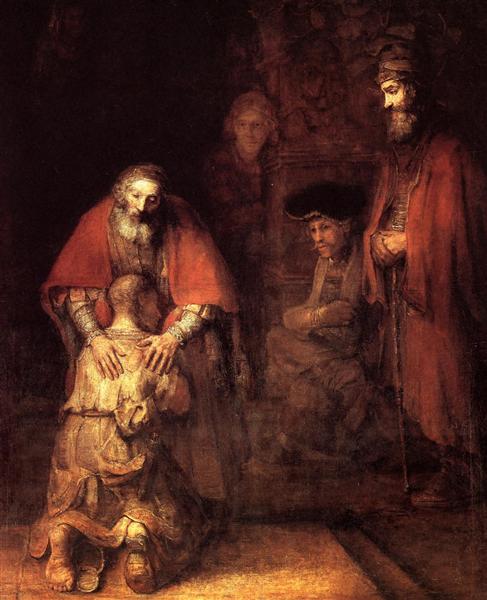
 The Return of the Prodigal Son, 1669 - Rembrandt - WikiArt.org

The first Rembrandt I ever saw was an original. 

The year was 1978. I was nine years old at the time, and living with my family in Germany. On a weekend trip to Amsterdam, we walked into an art museum and there it was - big, bright, and beautiful. I didn't know anything about it, but couldn't seem to take my eyes off of the grand scene before me. The valiant figures on the canvas looked like they might walk right out into the gallery and start talking to me. I was transported to another place and time, enveloped into the shadowy world of a 17th-century Dutch militia. Later on I learned that what I was looking at was a Rembrandt masterpiece, The Night Watch, one of the most famous paintings in the world.

That experience stuck with me through the years, so I was dismayed to hear that in 1990, thieves broke into a museum in Boston and stole $500 million worth of classic artwork, including paintings by Rembrandt, Degas, and Manet. It's considered the largest art theft in US history and remains unsolved to this day. The museum still displays the paintings' empty frames in their original locations. 

That describes much of Rembrandt's life - an empty frame. Rembrandt's first three children died as infants. His first wife then died, so he married again and had two more children. He eventually outlived them all and ended up burying all 7 members of his immediate family. Though considered one of the greatest artists of all time, Rembrandt had a difficult life, died penniless, and was buried in a pauper's grave. 

Rembrandt’s mother was Catholic and his father was Dutch Reformed. He attended his father’s church as a child, and though never formally becoming a member, he never seems to have lost his childhood faith. He continued to return to spiritual themes in his painting and etchings, especially in the wake of life's trials and tragedies. Some of his greatest biblical and religious works in the 1630's came about in the midst of great struggle, heartache, pain, and loss. This culminated with his poignant Return of the Prodigal Son, finished the year of his death, 1669.

Rembrandt had a great effect on many artists that came later, including Vincent van Gogh. On a number of occasions, van Gogh found himself in the midst of his own trials. In 1889, he was isolated and alone, locked up in a mental ward in France. He was anxious, irritable, deeply troubled, and under attack from all the pitfalls and pressures of life. Then he received a letter from his brother, Theo. In this letter, his brother included an etching that had been done by Rembrandt 200 some years before. As van Gogh looked at the etching by Rembrandt, he felt as though he had been raised from death to life. The etching by Rembrandt was entitled The Raising of Lazarus. 

He was so moved that he decided to do his own painting of the raising of Lazarus. In his version, van Gogh put to canvas what he could not put into words, and painted his own face as the face of Lazarus rising from the grave. 

Vincent van Gogh would later go on to say that, "Rembrandt goes so deep into the mysterious that he says things for which there are no words in any language." 

Here’s how the Apostle Paul puts it in his letter to the Romans: “The Spirit helps us in our weakness, for we do not know what to pray for as we ought, but the Spirit himself intercedes for us with groanings too deep for words” (Rom 8:26).

Rembrandt's paintings can help point us to something outside of ourselves, something greater and grander than the pain and suffering we may be experiencing in this world. That something is the gospel of Christ: the biggest and brightest and most beautiful thing ever conceived. It is a sight to behold, a true original, a work of art, a priceless possession, God's masterpiece, indeed.

“For I am sure that neither death nor life, nor angels nor rulers, nor things present nor things to come, nor powers, nor height nor depth, nor anything else in all creation, will be able to separate us from the love of God in Jesus Christ our Lord”  (Rom 8:38, 39).

+++


Friday, July 10, 2020

secrets in the dirt


Someone once asked golfing legend Ben Hogan for the secret to the game of golf. His answer? “The secrets are in the dirt.” What he meant was that nothing can replace good old-fashioned hard work out on the driving range. I think this can be said of the Bible as well when applied to the areas of history, geography, and archaeology. The people, places, and land are important. The secrets are in the dirt.

Christianity is different from other religions in this regard. Other more spiritual and ethereal religions such as Buddhism and Hinduism have no real need for historical settings and events. To quote historian Paul Maier, “Mythical personalities are not involved in authentic episodes from the past.” For those other systems to work, it doesn’t really matter whether the Buddha existed or if Vishnu had any basis in reality. These faiths are philosophical systems based on spiritual experiences and practical insights for living.

Christianity is different. It’s based on reality and grounded in history and geography. It’s a story about real people in the midst of real-life situations in real geographical locations. The Bible is chock full of names of people, places, and land features. There are names of oceans and rivers and streams and brooks, mountains and hills and valleys, cities and towns and villages, regions and provinces and empires. Many of these have been accounted for due to Biblical Archaeology. This science has helped immensely in providing evidence for the veracity of the Bible and the Christian faith.

Here are some Biblical characters we know from secular history as well as from the New Testament:

Roman emperors - Caesar Augustus, Tiberius, Claudius. Roman governors - Pontius Pilate, Sergius Paulus, Gallio, Felix, Festus. Local rulers - Herod the Great, Archelaus, Herod Antipas, Philip, Herod Agrippa. High priests: Annas, Joseph Caiaphas, Ananias. Prominent women - Herodias, Salome, Bernice, Drusilla. Prominent men - John the Baptist, James the Just.

Here are a few of the many archaeological discoveries from the past 100 years:

1947 - Dead Sea Scrolls
1961 - Pontius Pilate Stone
1968 - Peter’s House in Capernaum
1968 - Bone of a Crucified Man
1986 - First Century Fishing Boat
1990 - Joseph Caiaphas Ossuary
1993 - Tel Dan Inscription (House of David)
2004 - Siloam Pool
2007 – Herod’s Tomb
2009 – Magdala Stone
2015 – Hezekiah Seal
2018 – Isaiah Seal
2018 – Pilate's Ring

As evidence from the past continues to come to light and the reliability of the Scriptures and 
Christianity is made manifest, “the very stones cry out,” as Jesus himself said in Luke 19.

The disciplines of history and archaeology have assisted in demonstrating the integrity and accuracy of the Bible. This doesn’t automatically prove everything in it to be true, but it does mean that it is at least based in fact. The Bible and Christianity are grounded in history like no other holy book, religion, or philosophy. They are unlike the Greek myths, the Norse epics, or Aesop’s Fables. The Apostles and writers of the New Testament grounded the faith in eyewitness testimony and verifiable events. What Christians believe is based on reality and grounded in history, and verified by both geography and archaeology.

“That which was from the beginning, which we have heard, which we have seen with our eyes, which we have looked at and touched with our hands - this life was made manifest, and we have seen it, and testify to it and proclaim to you the eternal life, which was with the Father and was made manifest to us.” (1 John 1:1-2).

The secret to this life is no real secret to Christians. It may be a mystery, but it’s no secret. Christ has died, Christ has risen, Christ will come again. That’s the Christian faith in a nutshell. Christ is risen, Jesus is alive, and his tomb is still empty to this day. And just as he was raised from the dead by the glory of God the Father, we too will rise from our dirty graves to walk with him into new life.

(Thanks to Dr. Paul Maier for some of the facts and figures found in this article.)

+++


Saturday, June 27, 2020

scripture interprets scripture


In his first lecture on the psychological significance of the Bible, psychologist Jordan Peterson shared an image with the audience that he called “one of the coolest things he'd ever seen.” It was a visual representation of the entire Bible, which showed how the text of Scripture interacts with itself. The bar graph on the bottom represents all the chapters in the Bible, while the nearly 65,000 textual cross-references are depicted by colored arcs, which correspond to the distance between chapters. It’s an amazing example of the connected narrative within the Bible and how it speaks to and interprets itself.

This should come as no surprise to Reformation Christians. Sola scriptura has been part of our tradition for nearly 500 years. Scripture alone is the sole rule and norm for faith and life. Being the very Word of God in written form, the reformers also maintained that “Scripture interprets Scripture” which means that the Bible is its own interpreter.

This is a profound concept to be sure. But here is an even deeper truth: Scripture not only interprets itself but also interprets us. As we read and hear the Scriptures, the Holy Spirit convicts us of our sin and then points us to Christ so we can be comforted by the Gospel. “For the word of God is living and active, sharper than any two-edged sword, piercing to the division of soul and of spirit, of joints and of marrow, and discerning the thoughts and intentions of the heart” (Heb 4:12).

This is why we take great care when approaching the text of Holy Scripture, coming before God’s Word in deep humility, and not believing that our 21st-century ideas and interpretations are somehow more enlightened. Holy Scripture was given by God and inspired by the Holy Spirit to reveal divine truth to fallen man. But this is not just another set of divine “truths” to follow. This is the revelation of truth itself in the story of the promised Messiah and Savior of the world, the crucified and risen Lord Jesus Christ. As Luther wrote, “the Bible is the manger in which Christ is laid.”

So what do we really mean when we say “Scripture interprets Scripture?” In short, it means that as we engage in hermeneutics (the art of interpretation), we interpret the implicit by the explicit and the cloudy through the clear. The clear passages of Scripture that speak of justification by grace through faith in Christ (the central theme of the Bible) are used to interpret more difficult passages.

Here are two key phrases to keep in mind in the pursuit of faithful biblical interpretation. “Context is king,” and, “a text without a context is a pretext.” What we strive to do is allow the context of a given passage to help dictate how we interpret it. We begin with the immediate context of the phrase or sentence, then move to the paragraph, then the chapter, and then the book. Finally, because Christ himself claims all of Scripture as a testimony to himself, we allow the Old Testament to be interpreted in light of the New Testament, and vice versa (Luke 24:44). As St. Augustine famously said, “The Old Testament is the New Testament concealed, the New Testament is the Old Testament revealed.”

We also try to keep the literal sense of the text in mind, or the sensus literalis. In other words, we seek to interpret the text in the sense in which it was written and the way it was intended to be read. Whether we are reading narrative, poetry, history, prophecy, or a letter, we try to get into the shoes of the original hearers and read a text the way it was originally meant to be read.

Another idea important to the reformers was the perspicuity (or clarity) of Scripture. This means that the Scripture is clear in its main teachings and doctrines. People don’t need any special knowledge or training to understand sin, grace, forgiveness, and salvation. Do we fully comprehend everything found in the Bible? No, but we apprehend the main and plain things of Scripture by faith through the power of the Holy Spirit.

“As for you, continue in what you have learned and have become convinced of, because you know those from whom you learned it, and how from infancy you have known the Holy Scriptures, which can make you wise for salvation through faith in Christ Jesus. All Scripture is God-breathed and is useful for teaching, rebuking, correcting, and training in righteousness, so that the servant of God may be equipped for every good work” (2 Tim 3:16-17).

In the end, we believe the Bible because we believe in Jesus. Just as Jesus is both God and man, the Bible is also both God’s book and man’s book. We know that as Son of God and Son of Man, we are able to trust Jesus and his Word regarding all things. He has proven his faithfulness by means of his resurrection from the dead, so we know that everything he ever said or did is true. If he said it, we believe it, and that includes what he said about the Scriptures.

Unlike other religions, Christians don’t merely follow a book. We follow Christ, the very Word of God for us.

+++

Wednesday, April 8, 2020

heaven's not far away

Rev. Carla Cheatham on Twitter: "An original song, “Heaven's Not ...


If you ever find yourself in the middle of the Sistine Chapel at the Vatican in Rome, don't forget to look up. What you will see, along with many other depictions of biblical grandeur, is the Creation of Adam by Michelangelo. On the left side of the fresco is Adam lying on the ground, just about ready to come to life. On the right is God, rushing toward Adam with a divine purpose, surrounded by angels. And at the very center of the picture is a small empty space, the space between man and God, between heaven and earth.

I think it’s safe to say that most people today don’t think the space between heaven and earth is small. Most people think that heaven is a long way away. And that's not just because we don't like to think about our own mortality. It's also because we have been conditioned to think that heaven is a far off place, way out there somewhere, divorced from the earth. This is actually just good old-fashioned Gnosticism creeping back into our thinking as it always does. It's the idea from an ancient heresy influenced by Greek philosophy that heavenly spiritual things are good, while earthly physical things are bad. It's a false dichotomy that is antithetical to the Bible and to historic Christianity.

The Bible teaches that the natural state of things in this physical world is good. "God saw all that he had made, and behold, it was very good." (Gen. 1:31). Something went terribly wrong on the earth, of course, due to Adam and Eve’s fall into sin, but it is still God's good world and we are still part of his good creation. Maybe heaven is not as far off as we seem to think.

In one sense heaven is just another realm or sphere of reality. When Enoch "walked with God" in Gen. 5, he didn't have to go very far to be in God's eternal presence. He just entered a different dimension. The same goes for Elijah when his time was up and he was taken up by a chariot of fire into heaven. He didn't have to fly way past Jupiter to the edge of our solar system in order to get to heaven. He was simply taken into God's presence by way of a holy whirlwind. Similarly, when Jesus ascended into heaven forty days after his resurrection, he didn’t shoot like a rocket on his way to the moon. He simply disappeared from view into the cloud of God’s presence. It's really not distance that is the issue here - it is dimension.

It seems like this idea would be fairly easy for people to grasp these days, with all the talk about the multiverse, alternate realities, and the multiple dimensions that show up in Marvel movies. If actual scientists are seriously considering the possibility of a multiverse, why not investigate the claims of the Bible and the possibility of an alternate spiritual reality?

In the Christian worldview, heaven is right around the corner. When we pray to God, we aren't shooting random thoughts out into the stratosphere hoping that the universe will hear us somehow. We are praying to our Heavenly Father who loves us and cares about us and is willing and able to help us in our time of need. When we read the Bible or hear it spoken, it’s not just the dry words of a dead language from a 2000 year old book. It is nothing less than the living and active Word of our Creator, Redeemer, and Sustainer - the lover of our soul who's as close to us as our next breath.

The ultimate expression of this for Christians is when we go to the altar to receive the Lord's Supper together. What happens there is nothing less than amazing, as we receive the holy communion of Christ's body and blood given and shed for our forgiveness and salvation. Space and time fall away for a few brief moments and heaven and earth come together in a wonderful and mystical way as we commune together with our Lord, with one another, and with all the saints who have gone before us in every time and place. It is the closest we can come in this life to “heaven on earth”, until the day when Jesus returns and brings heaven with him, as the heavenly city, the new Jerusalem, descends from on high in the new creation.

Heaven may seem like a long way off right now, but it is as close to you as a gentle word spoken, a splash of water, a bit of bread, and a sip of wine. It may not look like much, but it is indeed the eternal mystery of God’s ultimate reality revealed in His Son Jesus Christ for you. Heaven opens up to you when you hear the pastor's words as from Christ Himself,  "I forgive you all of your sins in the name of the Father, and the Son, and the Holy Spirit. Amen."

If you ever make it to the Sistine Chapel in Rome, don’t forget to look up. But in the meantime, remember to look around you to see what God is doing in your very midst. You may be in for a big surprise, when you realize that heaven is not as far away as you think.

"Surely the Lord is in this place, and I was not aware of it. How awesome is this place! This is none other than the house of God; this is the gate of heaven."  (Gen. 28:17)

+++

Thursday, February 20, 2020

the pilgrim's promise


As a hiker I have always had a fascination with pilgrimages. Whether it be the Jesus Trail in Israel, the Pilgrim's Way in England, or the Camino de Santiago in Spain, there is something very compelling about going on a pilgrimage. To be on a quest, out in the wilderness, seeking truth, upward and onward, just you and God.

It turns out that I'm not alone. Millions of Christians go on pilgrimage every year, traveling all over the world to all kinds of places for all kinds of reasons. This is no recent phenomenon. Since at least the 4th century, Christian people have been traversing the globe for holy purposes.

It's no wonder why the book The Pilgrim's Progress has been so popular over the years. It was at one time second only to the Bible in popularity. It is the classic tale written by John Bunyan in 1678 about the journey of a young man named Christian from the City of Destruction through toil, trial, and trouble all the way to the Celestial City. It's an allegory, a great piece of literature, one of the first novels written in the English language.

There are many positive aspects about the book. It is filled with interesting characters like the Giant Despair of Doubting Castle, as well as creative place names like the Slough of Despond. From a theological point of view there are certainly some positives as well. The Bible is rightly held up as the only authority for faith and life. Sinfulness is shown as the natural condition of all men. The world is exposed as corrupt and broken, and salvation is needed for people to escape death and hell. That's all fine and good. But there's something missing - especially at the beginning of the story.

It's an element that, if it had been there in the first few paragraphs, the book could have been a whole lot shorter. So what is it? In short, it's the Gospel.

Before he leaves on his quest, Christian is burdened by his sin and the coming judgment upon the city. He meets the Evangelist and asks him, "What must I do to be saved?" Now, what Evangelist should have done (if he were really an evangelist) is preach the gospel to him! What he should have said was, "Believe in the Lord Jesus Christ and you will be saved! You and your whole family!" (Acts 16:31). But instead he hands a parchment to him that says, "Flee from the wrath to come." He can't even bring himself to say it, and he hands him a religious tract instead.

Another problem right at the outset is that Christian leaves his family behind to go on his quest. What happened to his vocation of husband and father? Even when they come running after him, he puts his fingers in his ears and runs away, caring only for his own salvation. We could spend a lot of time here on the doctrine of vocation, but that’s probably another article for another time.

It’s interesting to note that Martin Luther went on a pilgrimage at one point in his life. In the year 1510, while at university in Erfurt, Germany, he traveled all the way to Rome on foot - a journey of over 1,000 miles that took 70 days one way. He was excited at first to see the grandeur of Rome, but when he got there he was quite disappointed to find widespread corruption and abuse taking place at the highest levels of the church. It was an important reality check for him, and he came back to Germany more determined than ever to clearly and boldly proclaim the truth of God’s Word.

In the fall of 2010, for the 500th anniversary, a writer named Andrew Wilson  retraced the journey that Martin Luther made from Erfurt, Germany to Rome. One thing he came to realize is that Luther would have been a hiker his whole life long, not just during his long pilgrimage to Rome. He would have had to walk pretty much everywhere. Just like Jesus.

They say that the journey of a thousand miles begins with a single step. What they don’t tell you is that Jesus has already made the journey for you. He’s already walked the road. He’s already made that pilgrimage. He’s paved the way as our pioneer and perfector, the founder and finisher of our faith. For he went the way of sorrows, the Via Dolorosa, all the way to the cross and to the tomb for us and for all.

That’s a good reminder for us as we continue to celebrate the Reformation, this year highlighting  Luther’s important work from 1520, The Freedom of a Christian.  For that is what the Reformation was and is all about. The freedom that comes by God’s grace through faith in Christ alone. For ultimately the Christian life isn't about progress, it's about a promise. The Pilgrim's Promise.

+++

Thursday, January 30, 2020

the gospel is a noun

Image result for the gospel"


The men of the city had gone off to war. The women and children and elderly remained back home, anxiously awaiting word of the results of battle. Good news would mean great joy and celebration for the people, while bad news would mean distress and despair. Finally, the scout spotted a lone figure running over a hill toward the city. It was the herald bringing news from the battlefield! As he approached, the townsfolk began to hear his proclamation, “Good News! We have overcome the enemy! We have won the victory!”

This is the original usage of the word gospel in the ancient Greek world. A herald or messenger (keruks or angellos) would bring a message from the front lines of battle back to those awaiting word on how things were going. A “euangelion” was the good news message that the victory (nike) had been won, which was followed by great joy and celebration. Whether it’s greek, latin, or english - euangelion, evangel, good spell, or gospel - it all means a good report or a good message.

Today the word gospel is used in all kinds of different ways, often as an adjective. There’s gospel music, gospel tracts, gospel projects, gospel cruises, gospel churches, etc. There are all kinds of gospel things out there in our world today. But the Apostle Paul reminds us that there is really only one true gospel, and that is the good news gospel message about Jesus Christ, the Son of God, and his death and resurrection for us in our place.

“Now, brothers and sisters, I want to remind you of the gospel I preached to you, which you received and on which you have taken your stand. By this gospel, you are saved, if you hold firmly to the word I preached to you. For what I received I passed on to you as of first importance: that Christ died for our sins according to the Scriptures, that he was buried, that he was raised on the third day according to the Scriptures, and that he appeared to Cephas, and then to the twelve. After that, he appeared to more than five hundred of the brothers and sisters at the same time, most of whom are still living, though some have fallen asleep. Then he appeared to James, then to all the apostles, and last of all he appeared to me also, as to one abnormally born” (1 Cor 15:1-8).

As Dr. Rod Rosenbladt is fond of saying, there’s not a single thing about us in that entire passage. It’s mainly objective truth and not subjective experience. Although we are involved in the process of hearing and believing the gospel, it’s ultimately something that is done to us and for us from the outside. It’s a delivery of historical facts that tells us who Jesus is and what he has done for us through his dying on the cross and his rising from the grave.

St. Mark begins his book, “The beginning of the gospel of Jesus Christ, the Son of God.” That’s what it’s all about. The titles of the four books we know as “Gospels” in the New Testament bear this out. The Gospel, according to Matthew, Mark, Luke, and John. There are four books - but not four different gospels. There is one good news gospel message witnessed and testified to by four different people.

Paul goes on to explain the meaning of this gospel in the first chapter of his letter to the Romans:
“Paul, a servant of Christ Jesus, called to be an apostle and set apart for the gospel of God - the gospel he promised beforehand through his prophets in the Holy Scriptures regarding his Son, who as to his earthly life was a descendant of David, and who through the Spirit of holiness was appointed the Son of God in power by his resurrection from the dead: Jesus Christ our Lord ... For I am not ashamed of the gospel, because it is the power of God for salvation to all who believe: first to the Jew, then to the Gentile. For in the gospel the righteousness of God is revealed, a righteousness that is by faith from first to last, as it is written, ‘the righteous will live by faith.” (Rom. 1:1-4, 16-17).

The gospel is the dynamite power of God in Christ for you. The gospel says that it is finished, that the devil is defeated, and that death is destroyed. The gospel says that Christ is risen and Jesus is living and that in him, you have free forgiveness and full salvation forever. Not because of anything you have done, but simply because God loves you enough to come save you and rescue you. That is the greatest good news the world has ever known. And it’s not just any good news; it’s good news for you. “The time has come. The kingdom of God has come near. Repent and believe the gospel” (Mark 1:15).

In ancient times, after the herald would bring his message of good news to the people, they would often go out to meet the conquering leader as he came back to the city. After they all went out to meet him, they would return to the city to continue the victory celebration. This is a picture of what Jesus’ triumphal entry into Jerusalem looked like on Palm Sunday, as well as his return on the last day when he comes again as our conquering king, bringing the heavenly Jerusalem with him in the new creation.

+++

Monday, January 20, 2020

come and see

Image result for fireworks nazareth"

A few weeks ago I saw a video of fireworks going off in Nazareth on New Years Eve. The person filming was on the roof of his building, so he was able to capture quite a spectacular panoramic display. There was an anticipation and excitement in the air, as the sky was filled with color and flashes of light. Everyone in Nazareth that night would have been able to see the light.   

Quite a contrast between Nazareth now and Nazareth of two thousand years ago. The light of the world, the light of light, the very god of very god had come to dwell with them - but hardly anyone seemed to notice. Isaiah 9 states that "the people who walked in darkness have seen a great light." But had they? It sure didn't seem like it.

When the holy family returned to Nazareth from their sojourn in Bethlehem and Egypt, they began to lead a fairly provincial life. Joseph went to work in the carpentry shop while Mary worked at home, raising Jesus and the other children who would come later. Nothing much happened out of the ordinary (as far as we know) until Jesus turned twelve and they traveled to the temple in Jerusalem for the Passover. That's when his parents lost track of him and weren't able to find him for several days. When they finally found him teaching the teachers at the temple, he said to them, "Why were you searching for me? Did you not know that I must be in my Father's house?" (Luke 2:49)

That's the only episode we have in Scripture from the events surrounding his birth until the beginning of his ministry that seems to show that there was something special about this boy. From all accounts, everyone in Nazareth would have just thought of Jesus as a very good boy who obeyed his parents and worked hard with his father as a tekton's apprentice in the family trade. (A tekton was a builder who worked with wood and stone.)

That's why the townspeople in Nazareth were so shocked when Jesus began his ministry in Galilee preaching, teaching, and healing people. "Isn't this Joseph's son, whose father and mother we know?" (John 6:42). "Isn't this the carpenter's son? Isn't his mother's name Mary, and aren't his brothers James, Joseph, Simon and Judas? Aren’t all his sisters with us? Where did this man get all these things?” (Matt. 13:55,56).

It's also why Nathanael responded the way he did when Philip told him that they had found the Messiah in Nazareth. "Nazareth? Can anything good come out of Nazareth?" Philip's response was simple and to the point. "Come and see."

That's our invitation this Epiphany season as well. Come and see Jesus being baptized by John in the Jordan as he begins his earthly ministry. Come and see him overcoming the devil's temptations in the wilderness. Come and see him turn water into wine in Cana. Come and see him on the mountain peak, as he gives us a peek of his glory. Come and see him descend to the plain, as he sets his face toward Jerusalem and to the cross, to die for our sins and the sins of all the world.

Five years ago I was on a tour of Israel and had opportunity to be in Nazareth to see the massive bronze door at the Church of the Annunciation. It has six main panels that depict scenes from the life of Christ - from his birth, to his baptism, to his ministry, and finally to his death on the cross.

It's too bad that door wasn't there for the local townsfolk to see 2,000 years ago. It might have cleared a few things up for them. But the good news is - it's there for us now. And not just over there in the Holy Land - but right here in the palm of our hand through the Word of God.  During this Epiphany season Jesus is not only the Light, he is also the door - the way to forgiveness, salvation, and life eternal. Come and see!


Image result for nazareth door"