Monday, November 16, 2020

faithful in the fire


The end of the church year is a funny thing. It’s the time of year when you’re not quite sure whether you’re at the end of the beginning or the beginning of the end, especially in a year like this one. I think we can all agree that the phrase “hindsight is 20/20” will have a whole new meaning from now on.

This is also the time of year (even in good times) when melancholy, depression, and despair can set in. As we see the years go by and the season’s pass, it can become easy for us to see our lives as just an exercise in futility. Just the same ol’ same ol’. Nothing lasts, nothing matters, nothing seems worthwhile. Like the poet who wrote that “nothing gold can stay.” Or the philosopher who said that life is just a bad joke. Or Shakespeare’s Macbeth, who said that life is a tale, told by an idiot, full of sound and fury, that signifies nothing.

So what’s the answer? Where do we go to find meaning and purpose and significance for our lives? The Bible. The Scriptures. God’s Holy Word to us and for us: this is where we flee for comfort and hope in times such as these, as we are reminded that there is a plan and a purpose because there is a God. We may be lost and lonely at times - but God’s Word reminds us that we are never alone.

Just look at the lives of Hananiah, Mishael, and Azariah. Those were their Hebrew names anyway. Most people know them by their Babylonian names from the story of the fiery furnace in Daniel 3: Shadrach, Meshach, and Abednego.

These three young men were captives in Babylon along with Daniel in the 6th century BC, and the authorities told them that they had better get with the program. The King of Babylon, Nebuchadnezzar, had built a huge statue (probably of himself) that was over 100 feet tall and commanded everyone in the kingdom to bow down and worship it. That included all of the Jewish exiles from the land of Israel who were there living in captivity at the time. They were all supposed to bow down and worship this thing. And if you didn’t? Well, let’s just say it wouldn’t end well.

Typically at this point in the story, we are told of the courage and faithfulness that the three young Israelites displayed in the face of imminent danger and threat of death. But if we go back one chapter to Daniel 2, we find the real source of their strength. 

“Then Daniel returned to his house and explained the matter to his friends Hananiah, Mishael, and Azariah. He urged them to plead for mercy from the God of heaven concerning this mystery so that he and his friends might not be executed with the rest of the wise men of Babylon. During the night, the mystery was revealed to Daniel in a vision. Then Daniel praised the God of heaven and said: ‘Praise be to the name of God for ever and ever; wisdom and power are his. He changes times and seasons; he deposes kings and raises up others. He gives wisdom to the wise and knowledge to the discerning. He reveals deep and hidden things; he knows what lies in darkness, and light dwells with him. I thank and praise you, God of my ancestors: You have given me wisdom and power, and have made known what we asked of you” (Dan. 2:17-23).

The young men were praying to Yahweh, the God of Israel, for divine deliverance, not merely because they believed him to be the one true God, but because he had proven himself faithful to his people in the past. He was the One who had made a promise to Abraham and his descendants, the One who had brought the children of Israel out of Egypt through his servant Moses, and the One who led his people into the promised land of Canaan, a land flowing with milk and honey. Even when foreign enemies came in to ravage the land and take the people away as captives, God was still with his people and faithful to his promise.  

That’s why, when Nebuchadnezzar threatened to fry them alive in the fiery furnace, they were able to give such a bold and brave answer. “King Nebuchadnezzar, we do not need to defend ourselves before you. If we are thrown into the blazing furnace, the God we serve can deliver us from it, and he will deliver us from your hand. But even if he does not, we want you to know, Your Majesty, that we will not serve your gods or worship the image of gold you have set up” (Dan. 3:16-18).

Although theirs is an impressive show of faith, the display of God’s faithfulness to them is far greater. After all, faith is only as strong as the object in which it is placed. Fortunately for them, the object in this case is very great indeed, so great that not even the heavens above can hold him, let alone a temple or an idol made by human hands. And yet, in mercy, he deigns to dwell with his people, to deliver and to save.

“Fear not, for I have redeemed you; I have called you by name; you are mine. When you walk through the fire, you will not be burned; the flames will not set you ablaze. For I am the Lord your God, the Holy One of Israel, your Savior” (Isa. 43.)

King Nebuchadnezzar’s anger finally boiled over, so he turned up the ovens and had the three men thrown into the flaming furnace. As the king looked on, he couldn’t believe what he was seeing. “Did we not cast three men into the fire? Look, I see four men in the furnace, unbound, unharmed, and the fourth one looks like a son of god!” 

How good to know that wherever two or three are gathered in God’s name, there is always a fourth! And who is he? Nebuchadnezzar calls him a son of god. Daniel and Ezekiel call him the son of man. But it’s the same person. This son of God and son of man is none other than the second person of the Trinity, the pre-incarnate Jesus Christ himself. 

This is a preview and foreshadowing of the greatest act of faithfulness and deliverance in history, when 500 some years later, this God/Man went through the fires of hell for us and for all on an old rugged cross atop a rocky hill outside of Jerusalem. In the midst of his torment he cried out, “Eli Eli lama sabachthani! My God, My God, why have you forsaken me?” And when it was all over, he uttered one word, “Tetelestai.” It is finished, the debt is paid, and it’s paid in full. 

Because Jesus was forsaken by his Father on the cross in our place, we can rest assured that he will never leave us nor forsake us. Because Jesus was abandoned and alone - we never will be.  

“I will be with you always, to the very end of the age” (Matt. 28).

+++


Friday, November 6, 2020

Who Am I?


"Who Am I" by Dietrich Bonhoeffer


Who am I? They often tell me

I stepped from my cells confinement

Calmly, cheerfully, firmly,

Like a squire from his country house.


Who am I? They often tell me

I used to speak to my warders

Freely and friendly and clearly,

As though it were mine to command.

Who am I? They also tell me

I bore the days of misfortune

Equably, smilingly, proudly,

like one accustomed to win.


Am I then really that which other men tell of?

Or am I only what I myself know of myself?

Restless and longing and sick, like a bird in a cage,

Struggling for breath, as if hands were compressing my throat,

Yearning for colors, for flowers, for the voices of birds,

Thirsting for words of kindness, for neighborliness,

Tossing in expectations of great events,

Powerlessly trembling for friends at an infinite distance,

Weary and empty at praying, at thinking, at making,

Faint, and ready to say farewell to it all.


Who am I? This or the Other?

Am I one person today and tomorrow another?

Am I both at once? A hypocrite before others,

And before myself a contemptible woebegone weakling?

Or is something within me still like a beaten army

Fleeing in disorder from victory already achieved?


Who am I? They mock me, these lonely questions of mine.

Whoever I am, Thou knowest, O God, I am thine!


+++

Tuesday, October 27, 2020

righteous freedom


No matter what he tried, he couldn’t do it. Whether it was fasting, praying, confessing, self-flagellating - nothing seemed to help. He just couldn’t attain the righteousness of God on his own. Instead of feeling closer to God, it seemed like he kept getting further away. Even worse, it almost felt like God had become his enemy.

As a monk in the Augustinian monastery at Erfurt, Martin Luther zealously sought the righteousness of God. “If ever a monk got to heaven by his monkery, it was I”. He would later realize that the righteousness of God is not something that man must strive to attain, but a gift that is to be received. God had already brought down to him what he was trying so hard to reach up and grasp.

When Luther finally came to the end of himself, he found Christ’s righteousness right there waiting for him. When he turned to his mentor Staupitz for counsel on the matter, he was told to cling to Christ and recite the verse from Psalm 119, “I am yours Lord, save me.”   

When God made a promise to Abraham in Genesis 15 that he would have a son, Moses wrote that “Abraham believed God, and it was credited to him as righteousness.” What did Abraham have? He didn’t seem to have much of anything. He was an old man married to a barren woman. He was a wandering Aramean from the pagan land of Ur. He didn’t have a house, a land, a church, or a Bible. All he had was God’s promise. It doesn’t seem like much, but as it turns out, it was more than enough. In fact, it was more than he would ever need.    

Both the Old and New Testaments reveal to us that God saves his people by grace through faith in his promise. The Old Testament saints were saved as they looked forward in faith and believed in the promise of the coming Messiah. New Testament believers are saved by faith as we look back and believe in the Messiah who has come. God declares a person righteous in his sight by faith in his Son, or as Luther put it, a simple “trust of the heart.” We receive that faith by the power of the Holy Spirit through the means of grace, the word and the Sacraments (Baptism and the Lord’s Supper).

The two most important things to God in the Old Testament, justice and righteousness, are fulfilled in the person and work of his son, Jesus Christ, the Messiah of Israel and Savior of the world. By the passive righteousness of his sacrificial death on the cross for us, we are justified, forgiven, and set free. And by the active righteousness of his holy life in our place, we are given his purity and holiness as a royal robe of righteousness to stand blameless before God the Father in heaven. 

Is it any wonder that when Luther discovered this stunning truth as he studied the book of Romans in the cloister tower, that he felt as if the gates of heaven had finally been opened to him?  

I meditated night and day on those words until at last, by the mercy of God, I paid attention to their context: “The righteousness of God is revealed in it, as it is written: ‘The righteous person lives by faith.’” I began to understand that in this verse the righteousness of God is that by which the righteous person lives by a gift of God, that is by faith. I began to understand that this verse means that the righteousness of God is revealed through the Gospel, but it is a passive righteousness, i.e. that by which the merciful God justifies us by faith, as it is written: ‘The righteous person lives by faith.’ All at once I felt that I had been born again and entered into the gates of paradise itself. Immediately I saw the whole of Scripture in a different light. I ran through the Scriptures from memory and found that other terms had similar meanings; the work of God, that is, what God works in us; the power of God, by which he makes us powerful; the wisdom of God, by which he makes us wise; the strength of God, the salvation of God, the glory of God. I exalted this sweetest word, ‘the righteousness of God,’ with as much love as before I had hated it with hate. This phrase of Paul was for me the very gate of paradise. (Luther’s Works 34)

The gates of paradise are opened up to us today as well. By our baptism and belief in Jesus, through his dying on the cross and rising from the grave, we are now offered free forgiveness and full salvation by our gracious God. We not only experience God’s tender mercy by not getting what we truly deserve (death and hell), we are also the recipients of his amazing grace by getting the riches that we don’t deserve (eternal life, heaven).  

Our debt of sin and guilt is fully paid for on behalf of Christ, and our account is actually credited with his perfect righteousness. His purity, piety, and perfection become our own. We now stand holy and blameless before our Heavenly Father as his own dear children, and we are set free to serve our neighbor in love. Luther writes in his explanation of the Third Article of the Creed, “that I may be His own and live under Him in His kingdom, and serve Him in everlasting righteousness, innocence, and blessedness, even as He is risen from the dead, lives and reigns to all eternity. This is most certainly true.”

“I am not ashamed of the gospel, for it is the power of God for salvation to everyone who believes: first to the Jew, then to the Gentile. For in the gospel the righteousness of God is revealed, a righteousness that is by faith from first to last, as it is written: “The righteous will live by faith” (Rom 1:16-17).

“If the Son set you free, you will be free indeed” (John 8:36).

+++


Wednesday, September 30, 2020

sunshine in september


It was just another typical fall day at the Kilns outside Oxford, England. The day began at 8 am with a full English breakfast and plenty of tea, of course. There was talk of a trip to the zoo, but fog began rolling in, so a bit of disagreement ensued over the day’s activities. Jack and his brother Warnie decided to go on ahead using the motorcycle and sidecar, while the ladies would follow later in the car. As they set out on the way to the park, the fog slowly lifted, and the sun began to shine. 

That unremarkable trip to the zoo on September 28, 1931, was the last in a long line of experiences that brought C.S. Lewis (Jack) back to the faith. Some people call it a conversion, but I see it more as a return home after a long and difficult journey. “The longest way round is the shortest way home.”

Lewis was brought up in the church as a boy in Belfast, Ireland. He had a happy and carefree childhood until his mother’s death to cancer when he was nine years old. His loss was traumatic and compounded by his father’s own despair and melancholy. Unable to function after his wife’s death, Jack’s father shipped both of his sons off to boarding school. 

Those were difficult years for the Lewis boys. After boarding school came college, and soon after, they joined the fight in World War One. The harshness of life and the horrors of war led them away from God and the church. Jack would later say that he was “very angry with God for not existing.” Fortunately, during this time, Jack was also introduced to George MacDonald and GK Chesterton, whose Christian worldviews influenced him sometimes without knowing it. “A young man who wishes to remain an atheist cannot be too careful of his reading.”

Back at Oxford after the war, one of the most important friendships of the century began when C.S. Lewis met JRR Tolkien. “Jack and Tollers,” as they were known, had a lot in common. They were both English professors who had a love for Norse mythology. They both lost their mothers at an early age. And they were both veterans who had fought in the Great War. These shared experiences would bring them together and strengthen their bonds of friendship and fellowship. They quickly became friends and enjoyed walking, talking, smoking, and drinking together. They would later establish the writers’ group known as the “Inklings,” which met at the Eagle and Child Pub in Oxford each week to read and discuss each other’s literary work.

Around this time, one of the fiercest atheists that Jack knew admitted that the evidence for the Gospels was surprisingly good, and that it seemed God had indeed entered into human history after all. “Rum thing. All that stuff about the Dying God. It almost looks as if it really happened once". The core of Jack’s atheism began to crumble as friends, acquaintances, and even authors of the books he was reading were all ganging up on him regarding the truth about the existence of God.

As he considered all of this, he finally let go of the reins and gave in. “That which I greatly feared had at last come upon me. I finally gave in and admitted that God was God, and knelt and prayed: perhaps, that night, the most dejected and reluctant convert in all England.”

Jack now believed in God, but he was not a Christian yet. That would come two years later, in September of 1931. It began with a stroll along Addison’s Walk in Oxford and continued in conversation late into the night at Jack’s place. Tolkien, Lewis, and another friend, Hugo Dyson, were discussing all the old myths that they loved, and how Christianity was the one true myth of history, the one that actually happened. 

Eight days later, after breakfast on September 28, 1931, Jack and Warnie headed out by motorcycle and sidecar on the way to the zoo. He would later write, "When we set out I did not believe that Jesus Christ was the Son of God, but when we reached the zoo I did. I had not exactly spent the journey in thought, nor in great emotion. ‘Emotional’ is perhaps the last word we can apply to some of the most important events. It was more like when a man, after a long sleep, still lying motionless on the bed, becomes aware that he is now awake."

From death to life. From darkness to light. The fog had lifted, and the Son was now shining bright.


Monday, August 24, 2020

the art of albrecht durer

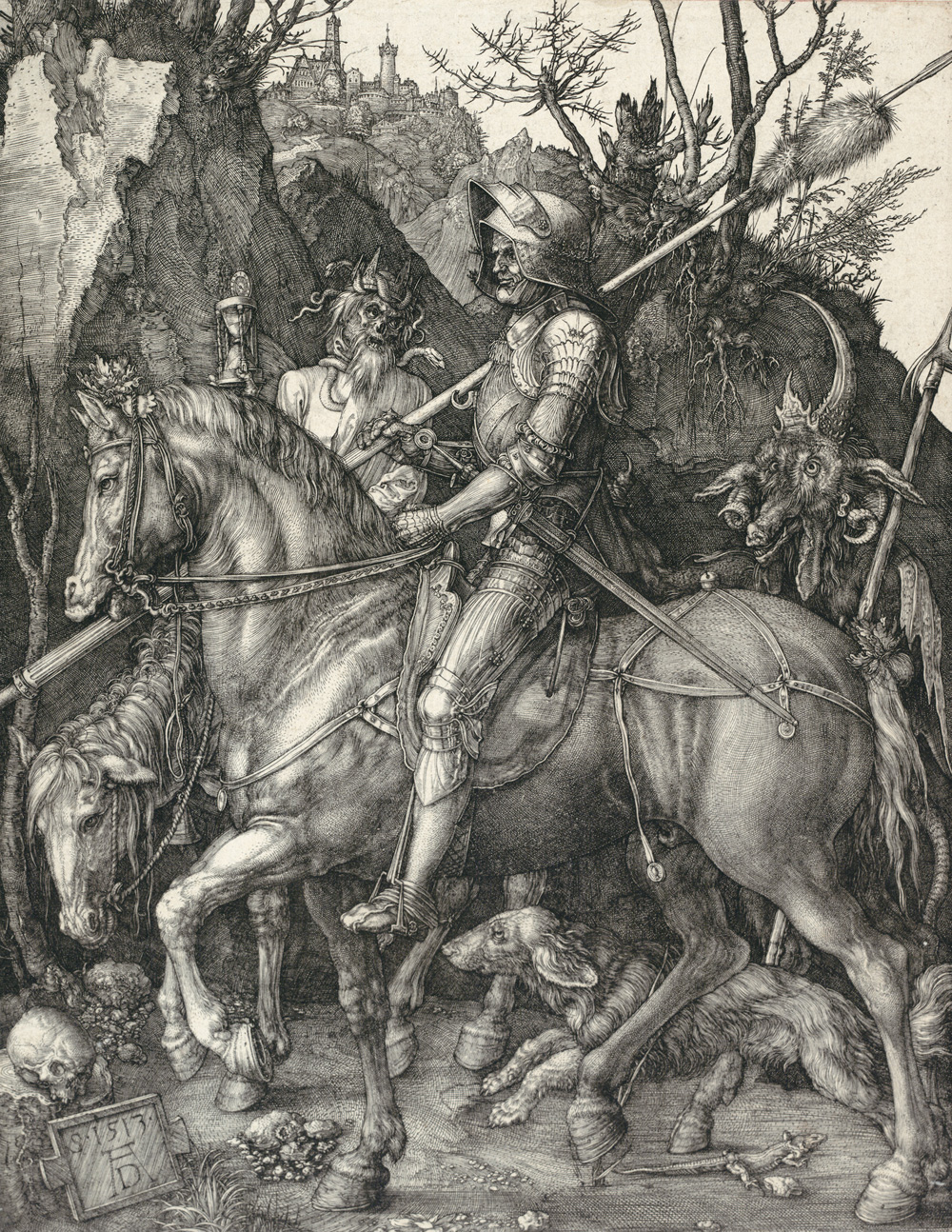
 Albrecht Dürer: Master Drawings, Watercolors, and Prints from the ...

When you think of great artists of the Renaissance, who comes to mind? Perhaps Da Vinci, Michelangelo, Raphael? Donatello, Caravaggio, or Bellini? My guess is that a German artist known mostly for his woodcuts is not the first to pop into your head, but Albrecht Durer is undoubtedly one of the greatest artists of the late Renaissance.

Durer was born in Nuremberg, Germany, in 1471. This was a time of great change and discovery in Europe. Renaissance means “new birth,” and that’s truly what this time was. It seems like world-changing events were taking place nearly every year. Martin Luther was born in 1483, Columbus discovered the New World in 1492, and perhaps most notable for young Albrecht, Gutenberg invented the printing press in 1440.

Durer’s father was a goldsmith, and his godfather was a printer and publisher. One of his godfather’s publications, the Nuremberg Chronicle, used hundreds of woodcuts to portray the history of the world, some of which young Albrecht may have worked on. His first significant work to be published was a woodcut which served as the title page for a volume of St. Jerome’s Letters in August of 1492.

The zeitgeist into which Durer was born was one of advancement as well as apocalypse. Religious and political change was on the horizon. The plague had continued to afflict the continent. Out of 18 children, Albrecht was only one of three who survived into adulthood. With the year 1500 approaching, a sense of fear and dread began to seize the masses. Durer felt this as well, and in 1498 he published the volume Apocalypse, a series of fifteen woodcuts portraying scenes from the book of Revelation. The most famous of these being The Four Horsemen of the Apocalypse and St Michael Fighting the Dragon. 

Another work with an end-times theme, Knight, Death, and the Devil, came about as the first of his series Meistertiche (or master prints). A knight rides confidently through a narrow valley surrounded by a demon and a figure of death riding a pale horse. Up above, a mighty fortress perched on a hilltop beckons the rider to endure and persevere through all the evils of this world to finally reach the eternal kingdom of God. It’s Durer’s medieval take on the line from Psalm 23, “Though I walk through the valley of the shadow of death, I will fear no evil.”  

Durer seemed to be quite interested in Martin Luther and the Reformation. He mentioned Luther several times in his writings, and he appears to have received a copy of Luther’s Babylonian Captivity of the Church in 1520. He also wrote of his desire to draw Luther in his diary from 1520: “God help me that I may go to Dr. Martin Luther as I intend to make a portrait of him with great care and engrave him on a copper plate to create a lasting memorial of the Christian who helped me overcome so many difficulties.” 

Durer died in August of 1528 at the age of 56. His monogram, a stylized AD, was a sign of his initials and a symbol of the Latin phrase “Anno Domini,” the year of our Lord. It is now a lasting memorial of the immense talent of this incredible artist and the God of all grace who inspired his work.  

+++

Saturday, August 8, 2020

remembering rembrandt

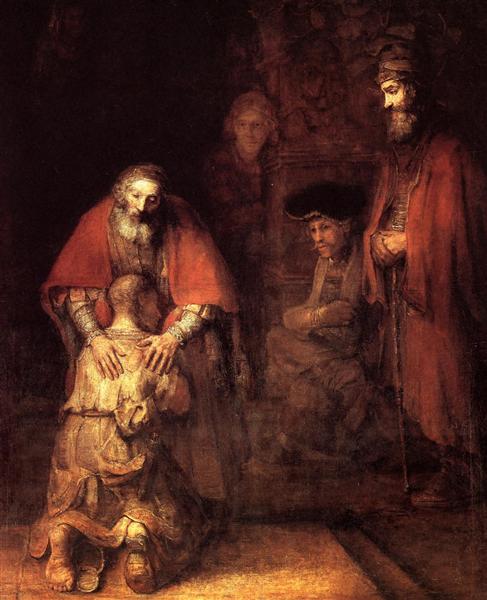
 The Return of the Prodigal Son, 1669 - Rembrandt - WikiArt.org

The first Rembrandt I ever saw was an original. 

The year was 1978. I was nine years old at the time, and living with my family in Germany. On a weekend trip to Amsterdam, we walked into an art museum and there it was - big, bright, and beautiful. I didn't know anything about it, but couldn't seem to take my eyes off of the grand scene before me. The valiant figures on the canvas looked like they might walk right out into the gallery and start talking to me. I was transported to another place and time, enveloped into the shadowy world of a 17th-century Dutch militia. Later on I learned that what I was looking at was a Rembrandt masterpiece, The Night Watch, one of the most famous paintings in the world.

That experience stuck with me through the years, so I was dismayed to hear that in 1990, thieves broke into a museum in Boston and stole $500 million worth of classic artwork, including paintings by Rembrandt, Degas, and Manet. It's considered the largest art theft in US history and remains unsolved to this day. The museum still displays the paintings' empty frames in their original locations. 

That describes much of Rembrandt's life - an empty frame. Rembrandt's first three children died as infants. His first wife then died, so he married again and had two more children. He eventually outlived them all and ended up burying all 7 members of his immediate family. Though considered one of the greatest artists of all time, Rembrandt had a difficult life, died penniless, and was buried in a pauper's grave. 

Rembrandt’s mother was Catholic and his father was Dutch Reformed. He attended his father’s church as a child, and though never formally becoming a member, he never seems to have lost his childhood faith. He continued to return to spiritual themes in his painting and etchings, especially in the wake of life's trials and tragedies. Some of his greatest biblical and religious works in the 1630's came about in the midst of great struggle, heartache, pain, and loss. This culminated with his poignant Return of the Prodigal Son, finished the year of his death, 1669.

Rembrandt had a great effect on many artists that came later, including Vincent van Gogh. On a number of occasions, van Gogh found himself in the midst of his own trials. In 1889, he was isolated and alone, locked up in a mental ward in France. He was anxious, irritable, deeply troubled, and under attack from all the pitfalls and pressures of life. Then he received a letter from his brother, Theo. In this letter, his brother included an etching that had been done by Rembrandt 200 some years before. As van Gogh looked at the etching by Rembrandt, he felt as though he had been raised from death to life. The etching by Rembrandt was entitled The Raising of Lazarus. 

He was so moved that he decided to do his own painting of the raising of Lazarus. In his version, van Gogh put to canvas what he could not put into words, and painted his own face as the face of Lazarus rising from the grave. 

Vincent van Gogh would later go on to say that, "Rembrandt goes so deep into the mysterious that he says things for which there are no words in any language." 

Here’s how the Apostle Paul puts it in his letter to the Romans: “The Spirit helps us in our weakness, for we do not know what to pray for as we ought, but the Spirit himself intercedes for us with groanings too deep for words” (Rom 8:26).

Rembrandt's paintings can help point us to something outside of ourselves, something greater and grander than the pain and suffering we may be experiencing in this world. That something is the gospel of Christ: the biggest and brightest and most beautiful thing ever conceived. It is a sight to behold, a true original, a work of art, a priceless possession, God's masterpiece, indeed.

“For I am sure that neither death nor life, nor angels nor rulers, nor things present nor things to come, nor powers, nor height nor depth, nor anything else in all creation, will be able to separate us from the love of God in Jesus Christ our Lord”  (Rom 8:38, 39).

+++


Friday, July 10, 2020

secrets in the dirt


Someone once asked golfing legend Ben Hogan for the secret to the game of golf. His answer? “The secrets are in the dirt.” What he meant was that nothing can replace good old-fashioned hard work out on the driving range. I think this can be said of the Bible as well when applied to the areas of history, geography, and archaeology. The people, places, and land are important. The secrets are in the dirt.

Christianity is different from other religions in this regard. Other more spiritual and ethereal religions such as Buddhism and Hinduism have no real need for historical settings and events. To quote historian Paul Maier, “Mythical personalities are not involved in authentic episodes from the past.” For those other systems to work, it doesn’t really matter whether the Buddha existed or if Vishnu had any basis in reality. These faiths are philosophical systems based on spiritual experiences and practical insights for living.

Christianity is different. It’s based on reality and grounded in history and geography. It’s a story about real people in the midst of real-life situations in real geographical locations. The Bible is chock full of names of people, places, and land features. There are names of oceans and rivers and streams and brooks, mountains and hills and valleys, cities and towns and villages, regions and provinces and empires. Many of these have been accounted for due to Biblical Archaeology. This science has helped immensely in providing evidence for the veracity of the Bible and the Christian faith.

Here are some Biblical characters we know from secular history as well as from the New Testament:

Roman emperors - Caesar Augustus, Tiberius, Claudius. Roman governors - Pontius Pilate, Sergius Paulus, Gallio, Felix, Festus. Local rulers - Herod the Great, Archelaus, Herod Antipas, Philip, Herod Agrippa. High priests: Annas, Joseph Caiaphas, Ananias. Prominent women - Herodias, Salome, Bernice, Drusilla. Prominent men - John the Baptist, James the Just.

Here are a few of the many archaeological discoveries from the past 100 years:

1947 - Dead Sea Scrolls
1961 - Pontius Pilate Stone
1968 - Peter’s House in Capernaum
1968 - Bone of a Crucified Man
1986 - First Century Fishing Boat
1990 - Joseph Caiaphas Ossuary
1993 - Tel Dan Inscription (House of David)
2004 - Siloam Pool
2007 – Herod’s Tomb
2009 – Magdala Stone
2015 – Hezekiah Seal
2018 – Isaiah Seal
2018 – Pilate's Ring

As evidence from the past continues to come to light and the reliability of the Scriptures and 
Christianity is made manifest, “the very stones cry out,” as Jesus himself said in Luke 19.

The disciplines of history and archaeology have assisted in demonstrating the integrity and accuracy of the Bible. This doesn’t automatically prove everything in it to be true, but it does mean that it is at least based in fact. The Bible and Christianity are grounded in history like no other holy book, religion, or philosophy. They are unlike the Greek myths, the Norse epics, or Aesop’s Fables. The Apostles and writers of the New Testament grounded the faith in eyewitness testimony and verifiable events. What Christians believe is based on reality and grounded in history, and verified by both geography and archaeology.

“That which was from the beginning, which we have heard, which we have seen with our eyes, which we have looked at and touched with our hands - this life was made manifest, and we have seen it, and testify to it and proclaim to you the eternal life, which was with the Father and was made manifest to us.” (1 John 1:1-2).

The secret to this life is no real secret to Christians. It may be a mystery, but it’s no secret. Christ has died, Christ has risen, Christ will come again. That’s the Christian faith in a nutshell. Christ is risen, Jesus is alive, and his tomb is still empty to this day. And just as he was raised from the dead by the glory of God the Father, we too will rise from our dirty graves to walk with him into new life.

(Thanks to Dr. Paul Maier for some of the facts and figures found in this article.)

+++